Main Street is where most people actually feel the economy. Retailers, tradespeople, restaurants, contractors, and local service providers don’t operate on national balance sheets—they live or die by what happens in their own communities. Right now those communities are under steady pressure: demand is softer, costs keep climbing, and the gap between the two is widening.
The squeeze hits small businesses hardest because they depend almost entirely on local customers and local spending. Multinational firms, by contrast, do most of their business outside the state, so the same conditions barely register on their bottom lines. When money stops circulating close to home, the businesses that rely on everyday local traffic feel it first. With less cash moving through the local economy, these same firms also have fewer resources to compete—for workers, for space, or simply to stay open—while larger companies with national or global revenue streams remain largely insulated.
Washington’s federal fiscal balance flipped back into the red in 2022 and has only gotten deeper since. After a couple of temporary surpluses during the pandemic years, the gap hit –$32.8 billion in 2022, –$34.5 billion in 2023, and –$39.9 billion in 2024. These numbers can feel distant until you see how they land on Main Street.
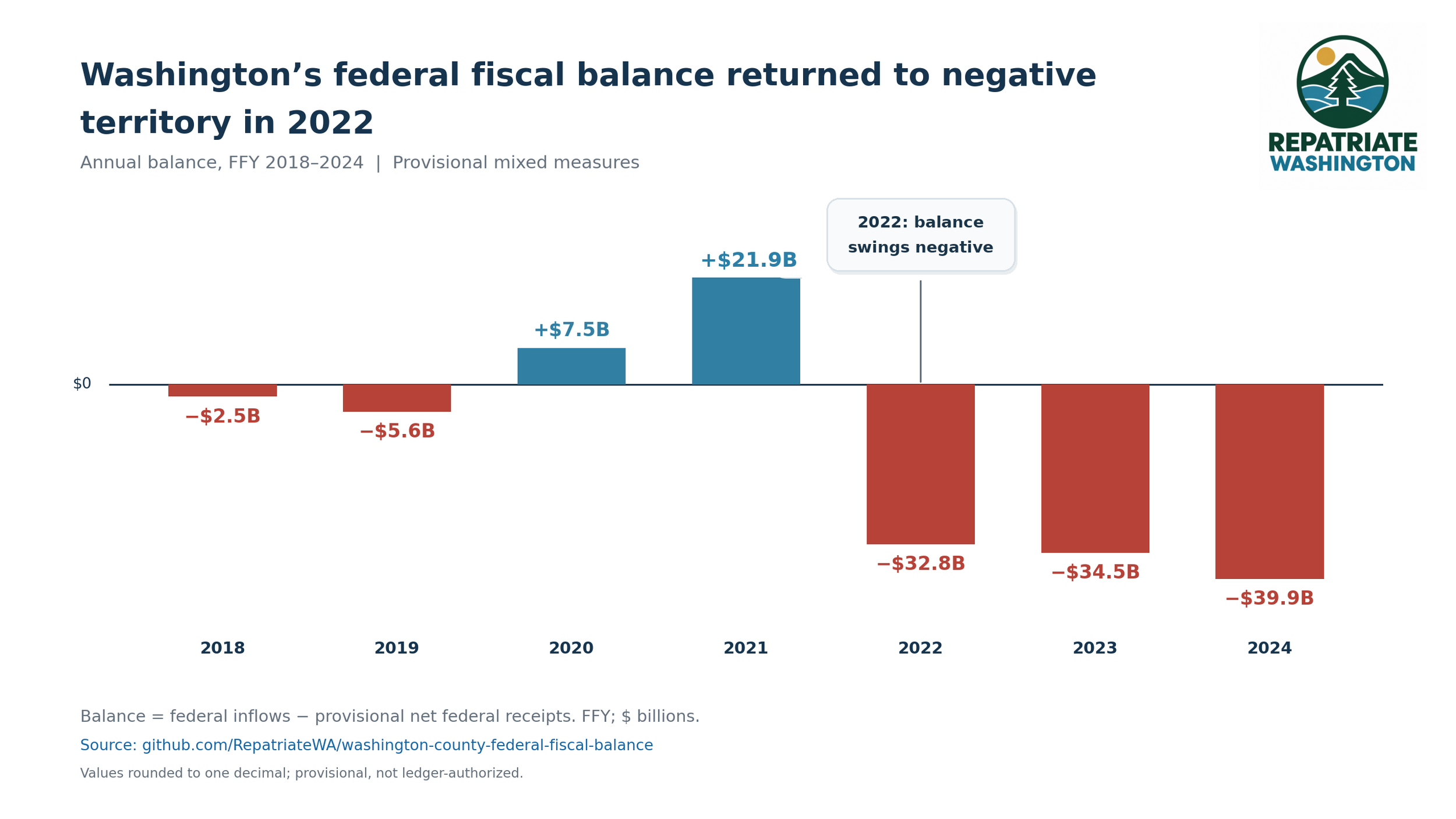
When money leaves the state and doesn’t come back through federal contracts, infrastructure work, or payrolls, it simply isn’t circulating in local communities anymore. A dollar that stays here tends to change hands several times: a paycheck becomes a haircut, then grocery money, then a mechanic’s bill. When tens of billions leave every year, that cycle slows. Sales cool off, credit gets tighter, and the quieter costs show up in the decisions that don’t get made—delayed hiring, postponed expansions, and investments that never happen.
Local governments feel the same pressure. Cities and counties still have to maintain roads, water systems, and emergency services. When less money is circulating, sales and commercial tax collections weaken. To close the gap, many jurisdictions raise property taxes, utility fees, permitting costs, or business license fees. Small businesses end up paying twice: once through federal taxes that leave the state, and again through higher local charges meant to fill the hole left behind.
It’s easy to blame soft sales or rising fees on ordinary economic cycles or local budget choices. That explanation is incomplete. Without clear data on how much federal capital is actually flowing out of the state and each county, business owners and chambers of commerce are working with only half the picture. They see the local pressure but miss the larger upstream drain that’s been accelerating since 2022.
That’s why we track these numbers county by county. The point is simple: show how much capital is leaving each community, give local business groups solid data to push for better procurement retention instead of automatic tax increases, and help keep Washington’s small-business base from being steadily drained.
Main Street needs local money circulating, workable credit, and costs that don’t keep climbing. When $30–40 billion leaves the state’s private economy every year, small businesses absorb the impact. Seeing these flows clearly is the first step toward protecting the commercial districts that actually keep communities running.
The full data is available here: github.com/RepatriateWA/washington-county-federal-fiscal-balance.