As lawmakers and budget writers in Olympia scramble to address multi-billion-dollar state budget shortfalls, Washington's political commentary remains fixated on surface-level squabbles.
For years, state tax debates centered on Business & Occupation (B&O) rates and sectoral surcharges. Recently, press headlines and legislative battles have been consumed by the $3.5 billion "millionaire tax" signed by Gov. Bob Ferguson—a 9.9% tax on high earners designed to fund state programs and tax relief.
Yet, while media outlets and policymakers spend endless energy litigating $3.5 billion in internal wealth redistribution, virtually no one in state government is auditing the $39.92 billion annual net outflow pulled out of Washington State by the federal government.
A federal capital extraction over 10 times larger than the state's most controversial tax legislation is occurring in broad daylight. Political commentators act as symptom merchants, obsessing over internal tax shifts while remaining completely blind to the massive macroeconomic current draining regional liquidity.
1. The Data: A $107 Billion Capital Drain
To understand why Repatriate Washington tracks federal balance data, look at how net fiscal flows (federal inflows minus IRS collections) shifted from 2018 through 2024:
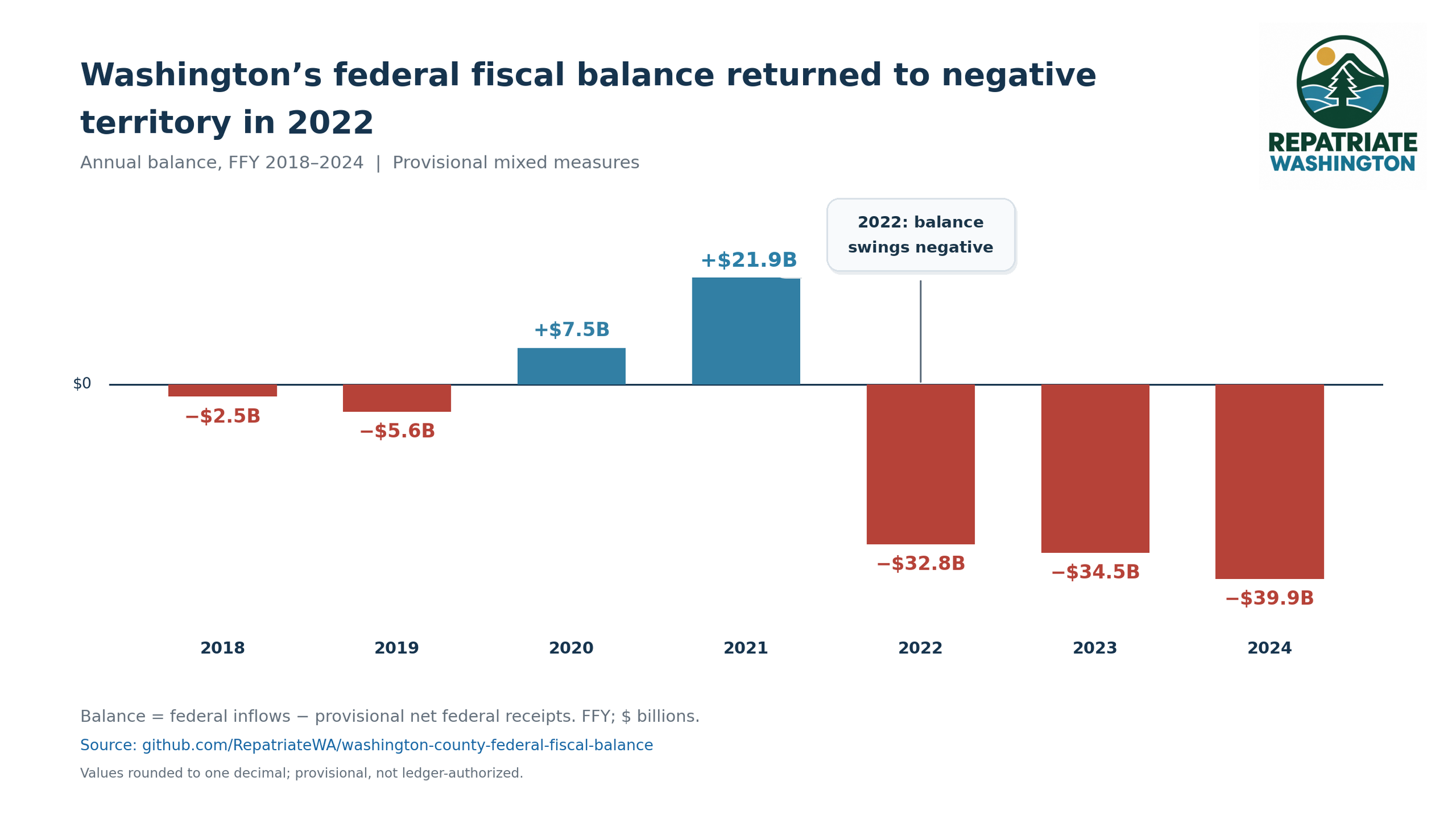
Between 2022 and 2024, $107.19 billion in net capital was extracted from Washington, reaching a record –$39.92 billion outflow in 2024 alone.
2. The Snowball Effect: Lost Revenues, Stalled Growth, Escalating Needs
Stripping $39.92 billion in purchasing power from a state economy per year causes an aggressive, compounding economic breakdown with zero positive offset:
Robbing the State Ledger of $8B–$12B in Organic Tax Revenue: Washington’s General Fund relies on retail sales tax (6.5%) and B&O gross receipts taxes. Tax revenue is a direct function of money velocity. Had that $107.19 billion stayed in Washington from 2022 to 2024, it would have generated $8 billion to $12 billion in organic state tax revenue—more than enough to eliminate Olympia’s budget deficit without raising taxes.
Depressing Velocity ($53B–$63B Impact): Applying standard regional spending multipliers ($1.35\times$ to $1.60\times$), a $39.92 billion direct extraction destroys $53.89 billion to $63.87 billion in annual statewide transaction volume.
Crushing Private Growth & Existing Enterprise: Removing this liquidity creates an opportunity loss equivalent to 200,000 to 250,000 uncreated jobs, forces existing businesses to underperform relative to their potential, and delays critical local infrastructure projects.
Escalating Safety-Net Demand: As private job creation grinds to a halt and wage growth flattens, more households are pushed onto state-funded healthcare, assistance programs, and public safety nets.
The State Budget Vise: Federal capital drain simultaneously shrinks state tax revenues while driving up public demand for state services.
3. Macro Headwinds Magnifying the Drag
This federal drain actively collides with three external macroeconomic shocks:
Tariff Friction & Trade Exposure: As a top trade-dependent state, international trade disruptions hit Washington hard. Because B&O taxes apply to gross receipts rather than net profits, trade compression cuts directly into state revenue while pushing up capital project costs.
Energy Volatility & Inflation Above Fed Targets: Global energy shocks—fueled by Middle East tensions involving Iran—push operational costs well above the Federal Reserve’s 2% target baseline. This acts as an unwritten tax on consumer discretionary spending and directly inflates line-item costs for the Washington State Ferry system, State Patrol, and highway crews.
Interest Rates & Debt Service: Elevated mortgage rates depress Real Estate Excise Tax (REET) revenues, while higher interest rates increase the state's debt service burden when issuing general obligation bonds.
4. The Blind Spot in Olympia
Governor Bob Ferguson and legislative budget writers inherit an accounting model designed to track internal agency cash flows—not regional monetary velocity.
State leaders view deficits purely as administrative math: balance agency requests against revenue forecasts, draw down reserves, or switch from historical B&O tweaks to new income-tier taxes.
By treating the state economy as a closed loop, executive leadership misses the $39.92 billion hole in the bucket. Policymakers are fighting over internal tax redistributions while remaining oblivious to the federal current pulling liquidity right out of the state's tax base.
5. Holding Washington’s Federal Delegation Accountable
State policy alone cannot fix an interstate capital drain. Washington’s U.S. Senators and Congressional Representatives must step up. While Olympia manages the General Fund, federal delegates oversee D.C. spending, tax policies, and procurement.
To close the $39.92 billion extraction gap, Washington’s federal delegation must be held to three mandates:
Prioritize Washington: Demand a higher share of federal defense, aerospace, energy, INFRASTRUCTURE and tech contracts for Washington-based enterprises to return extracted tax dollars to the state.
Reclaim Infrastructure Grants: Secure direct, non-discretionary federal grants to fund major state projects—bridge replacements, highway corridors, port upgrades, and ferry fleet modernization—without forcing Olympia to raise local taxes or issue high-interest municipal debt.
Audit Interstate Fiscal Imbalances: Sponsor legislation requiring the CBO and IRS to publish annual, transparent state-by-state net fiscal balance reports so D.C. can no longer ignore Washington’s capital drain.
The Bottom Line
Repatriate Washington tracks and publishes this data because you cannot fix a structural deficit if you only look at half the ledger. The goal is not to isolate Washington from national obligations, but to stop our economic engine from being continuously drained during an era of historic national debt.
Access interactive datasets, methodology documentation, and raw data files at our open data repository: https://github.com/RepatriateWA/washington-county-federal-fiscal-balance