Debating whether high-income states "should" subsidize other regions misses the structural reality.
The real issue facing Washington isn't political—it is macroeconomic capital extraction, broad fiscal drag, and compounding liquidity friction during an era of historic national deficit spending.
The Numbers: A $107B Three-Year Drain
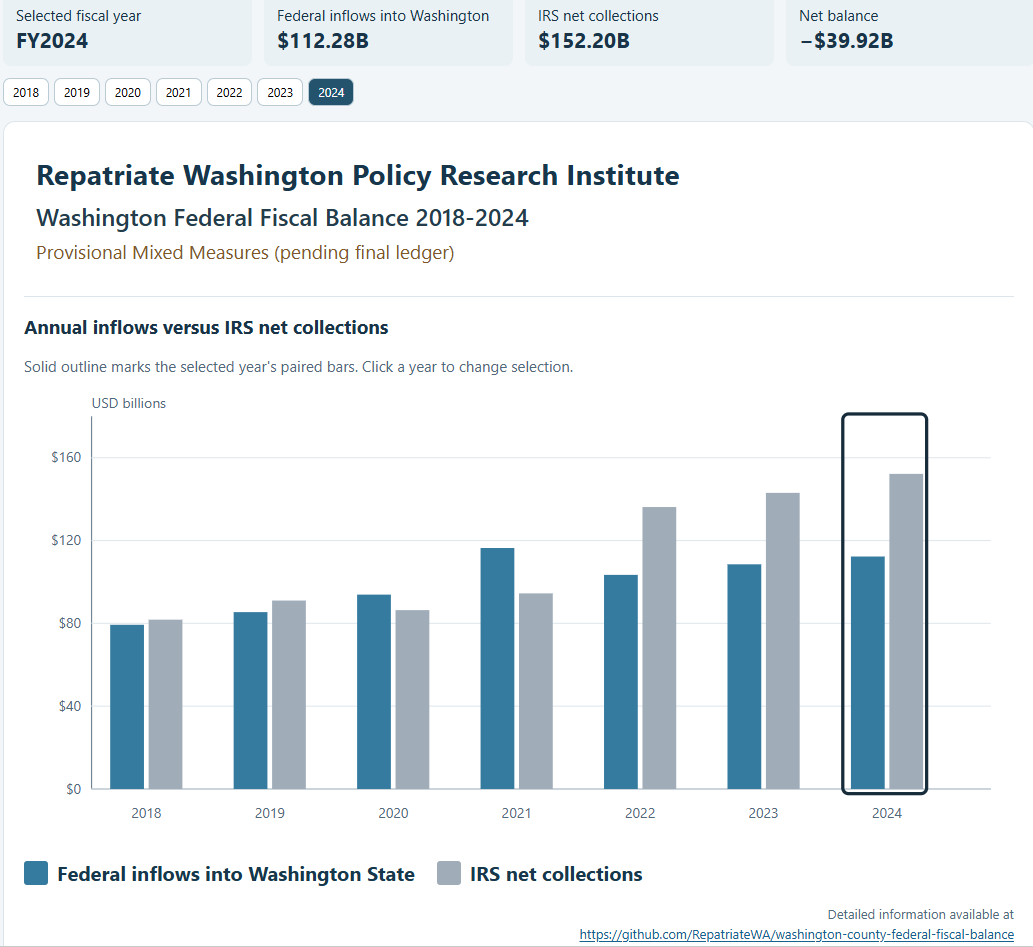
While pandemic relief temporarily injected +$29.39B into local balance sheets (2020–2021), Washington has since fallen into a record net deficit.
Bottom Line: Between 2022 and 2024, $107.19 billion in net capital was extracted from Washington State.
Macro Context: Upstream Against National Growth
Nationally, federal spending runs annual deficits near $2 trillion—injecting massive liquidity nationwide. Yet Washington State experiences a net fiscal contraction, pulling capital out of our regional economy to spend elsewhere. Washington is forced to row upstream against a broad national expansion.
3. How Fiscal Drag Hits the Local Economy
Extracting $39.92 billion in a single year causes compounding regional damage:
Lost Money Velocity: Applying standard spending multipliers ($1.35\times$–$1.60\times$), removing $39.92B directly eliminates $53.89B to $63.87B in total annual economic velocity.
Opportunity Cost: Sustaining a drain of this scale starves organic growth, resulting in 200,000 to 250,000 uncreated jobs and unbuilt expansion projects across the state every year.
4. The Local Double Vise: Slower Economy + 2% Inflation
State and city governments face a structural cost-shift driven by two opposing pressures:
Flat Tax Bases: Suppressed money velocity cools consumer spending and business turnover, flattening sales tax revenue.
Rising Baseline Costs: The Fed's 2% inflation target continuously drives up municipal expenses (wages, fuel, materials, equipment).
The Result: Cities face rising costs on stagnant revenues—forcing local governments to raise property taxes, levies, and municipal fees just to maintain baseline public services.
5. Why We Track This Data
Repatriate Washington tracks and publishes federal fiscal flow data because systemic economic drag cannot be solved until it is measured. While our current reporting focuses on statewide dynamics, we are actively developing the framework for county-level tracking to highlight local impacts across Washington.
Our work aims to:
Quantify Drag: Measure real capital extraction and its impact on state growth.
Diagnose Shortfalls: Show that municipal budget crises stem from federal liquidity drain—not just local spending decisions.
Advocate for Reinvestment: Build a transparent ledger to push for smarter federal procurement and capital retention
For interactive datasets, methodology documentation, and raw data files, visit our open data repository: https://github.com/RepatriateWA/washington-county-federal-fiscal-balance